What to Do if You Find a Bat
At least 50 rabid bats have been found in Los Angeles this year, serving as an important reminder for residents to know what to do if they encounter a bat in or around their home.
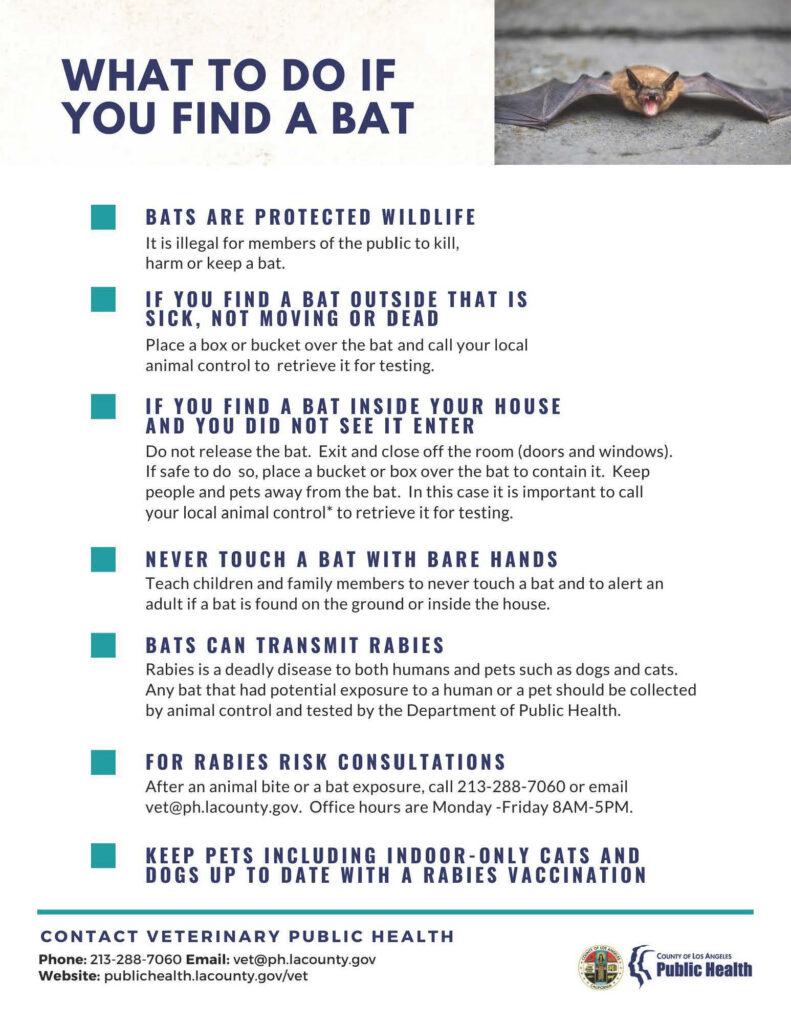
Bats are protected wildlife and should never be touched with bare hands. If you find a bat that appears sick, is not moving, or is dead, keep people and pets away. If it is safe to do so, place a box or bucket over the bat without touching it and contact local animal control.
If a bat is found inside your home and you did not see it enter, do not release it. Close off the room and call animal control so the bat can be retrieved and tested. Bats can transmit rabies, so any potential exposure involving a person or pet should be taken seriously. Keep pets up to date on their rabies vaccinations and teach children to alert an adult if they encounter a bat.
For rabies risk consultations, contact Los Angeles County Veterinary Public Health at 213-288-7060 or vet@ph.lacounty.gov, Monday through Friday from 8:00am–5:00pm. Additional information is available at publichealth.lacounty.gov/vet.

The Summer Villain: Mosquitoes
Mosquitoes are the world’s deadliest animal, responsible for spreading diseases to millions of people each year. Protect yourself from the bite by wearing insect repellent and eliminating standing water around your home.
Have mosquito issues? Contact Greater Los Angeles County Vector Control District (@GLAmosquito).
Visit GLAmosquito.org or call 562-944-9656.
LA County Moves to Take Over Homeless Service Payments from LAHSA
Los Angeles County officials approved a plan Tuesday to take over payments to homeless service providers after serious financial problems surfaced at the Los Angeles Homeless Services Authority, known as LAHSA. The move is intended to ensure providers are paid and that services for unhoused residents continue.
The Los Angeles County Board of Supervisors voted 5-0 to approve the plan introduced by Third District Supervisor Lindsey Horvath. The county will also place its own staff inside LAHSA to review financial records and monitor the agency’s payment system.
The action comes after Horvath revealed major problems with LAHSA’s financial obligations, including missed payments to service providers even though the county had already advanced funding to the agency.
“This problem is not new. We learned (in late February) that LAHSA cannot provide real financial information and has refused to allow county workers to provide them help, while county service providers remain unpaid,” Horvath said. “My phone is ringing off the hook from service providers.”
LAHSA Interim Chief Executive Officer Gita O’Neill responded to the concerns and said the agency is working to resolve the payment delays. She said the agency was overwhelmed by a large number of invoices.
According to O’Neill, the backlog was caused by contracting delays, outdated internal policies, and the loss of key staff members with institutional knowledge.
“We have identified many of the problems and are already taking corrective action,” O’Neill said.
Los Angeles County Acting Chief Executive Officer Joseph Nicchitta said the county will continue working with LAHSA through the end of the current fiscal year. After that, funding for homeless service providers will remain with the county and will be administered through the county’s Department of Homeless Services and Housing.
Nicchitta said LAHSA has historically carried over accounts, meaning some invoices and payments could continue beyond July. He said the county is currently waiting for documentation related to about $11 million in pending payments.
Under the motion approved by the Board of Supervisors, the county will directly pay homeless service providers for work performed under county-funded programs. County employees will also be embedded inside LAHSA to help address financial and administrative problems.
The board also ordered a full audit of LAHSA’s finances. The audit will be led by Los Angeles County Auditor-Controller Oscar Valdez and is expected to take two to three weeks.
Valdez will present an oral report to the Board of Supervisors on April 14. The report will include the results of the audit and a corrective action plan designed to improve transparency and ensure timely payments to service providers.
“I did meet with the county’s auditor-controller and the Homeless Services & Housing department leadership,” Nicchitta said on Tuesday. “We all agreed a review of LAHSA policies, procedures, financial records and advances was warranted. In order to make sure this does not happen again.”
Nicchitta said he has scheduled a meeting later this week with O’Neill to discuss the situation further.
LAHSA officials have said they are willing to cooperate with the county auditor-controller’s office and provide assistance during the review.
County officials are also coordinating with the City of Los Angeles. Nicchitta said he has been meeting with Los Angeles City Administrative Officer Matthew Szabo and his staff to share information.
“Information is being shared at those meetings. We are communicating,” Nicchitta told the Board of Supervisors.
Board Chair and First District Supervisor Hilda Solis said the public expects answers and that service providers should receive their payments.
“I will await to see what the auditor will report back. And for money to go to those providers. Our constituents want to know,” Solis said.
LA County Aims to End Veteran Homelessness by 2028
County Approves Action Plan to Help Homeless Veterans
Los Angeles County Supervisors have approved a new plan to eliminate veteran homelessness by 2028. The plan focuses on faster housing access, fewer bureaucratic delays, and stronger coordination with the U.S. Department of Veterans Affairs (VA).
Fourth District Supervisor Janice Hahn, who authored the plan, called it a moral duty to help those who served the country but now live on the streets. The motion passed 4-0 on November 18, with one supervisor absent.
Red Tape Slowing Progress
Despite ongoing efforts, veterans still face major delays. Hahn said county systems are fragmented, and veterans often struggle with confusing paperwork, inconsistent entry points, and slow verification processes.
One of the biggest problems is verifying someone is a veteran. The new plan calls for the VA to allow self-referral, which could reduce long wait times for housing.
Coordinated Efforts with State and Federal Partners
Jim Zenner, director of the county’s Military and Veterans Affairs office, said the key to success is close collaboration with the VA and state agencies.
“We believe we can get it done,” Zenner told the board. “We are going to get it done.”
Plan Highlights
The plan includes several steps:
-
Faster verification: Let veterans self-identify to speed up access to housing.
-
Build near workplaces: Find out where veterans work and build housing nearby.
-
Coordinate healthcare: Improve mental health and substance abuse services by aligning county and VA resources.
-
Support veterans with pets: Remove barriers that prevent veterans from bringing pets into housing.
Veteran Homelessness Trends
There were about 3,050 unhoused veterans in LA County in 2025. That’s down from 3,878 in 2023, but slightly higher than the 2,991 counted in 2024. The plan is expected to help resume the downward trend.
The overall homeless population in the county is over 72,000, according to a February 2025 count. Unsheltered homelessness dropped by 9.5% from the previous year.
Focus on High-Need Communities
Hahn said many homeless veterans are Black or Latino, living in areas like Compton, South Gate, East LA, and Inglewood. These communities face higher unemployment, poverty, and limited VA healthcare access.
Real-World Example in San Pedro
Hahn highlighted a successful project in San Pedro, where an old motel was turned into a veteran resource center. About 60 veterans lived there temporarily while transitioning into permanent housing.
“They just needed a safe, clean place to stay,” Hahn said. “They’ve gone back to school or found work.”
Call for Broader Support
Fifth District Supervisor Kathryn Barger supported the motion and said the city and county must align their efforts.
“The words ‘homeless’ and ‘veteran’ should never be in the same sentence,” Barger said.
Where to Get Help
Veterans in need can call 310-268-3350 Monday–Friday from 7:30 a.m. to 4:00 p.m. For help after hours, dial 2-1-1.
LA County Declares Emergency Over Immigration Raids
The Los Angeles County Board of Supervisors voted Tuesday to declare a local state of emergency in response to federal immigration raids that have shaken immigrant communities and caused economic hardship.
The declaration passed by a 4 to 1 vote, with Supervisor Kathryn Barger opposing.
The emergency status gives the board authority to offer rent relief and other assistance to residents who have lost income due to the raids. Many families have avoided public spaces out of fear. Others have lost income after family members were detained at bus stops, job sites, and other locations.
Supervisor Janice Hahn said her office has received calls from residents who still don’t know where their family members are.
“We have residents afraid to leave their homes, we have constituents contacting my office because their family members never came home and they don’t know if they’ve been taken by ICE or where they’ve been taken,” Hahn said. “We have entire families who are destitute because their fathers or mothers have been taken from their workplaces and they have no way to pay their rent or put food on their table.”
Supervisor Lindsey Horvath, who co-authored the motion, said the raids have disrupted neighborhoods and small businesses across the county. In August, more than 5,000 arrests were made in Los Angeles as part of an ongoing federal crackdown. About one-third of LA County’s 10 million residents are foreign-born.
Some cities canceled Fourth of July events and movie nights this summer as attendance dropped due to safety concerns.
According to Horvath’s office, rent relief will be distributed through an online portal expected to launch within two months. The declaration also allows the county to seek state funding for legal aid and support services. While this move does not enact an eviction moratorium, it could lead to one with separate action from the board.
Supervisor Barger voted no. She said the raids do not meet the legal definition of an emergency and raised concerns about the impact on landlords.
“I’m sure we’re going to be challenged legally,” Barger said, referencing lawsuits from the COVID-19 eviction moratorium.
During public comment, several speakers said they oppose another eviction freeze. Daniel Yukelson, CEO of the Apartment Association of Greater Los Angeles, said landlords are still recovering from billions of dollars in unpaid rent and lost income during the pandemic.
“If local jurisdictions once again allow rent payments to be deferred due to ICE enforcement activities, this will lead to the further deterioration and loss of affordable housing in our community,” Yukelson said.
“Housing providers are sympathetic to tenants and their family members affected by U.S. Immigration and Customs Enforcement activities,” he said, “but the association isn’t aware of anyone unable to pay rent because of immigration enforcement.”
The emergency declaration comes after weeks of protests and reports of National Guard and Marine deployments to assist with enforcement. Residents and advocates say it has caused widespread fear and financial instability in communities across Los Angeles County.
Rental Relief Measure Returns to LA County Supervisors, Gains Approval and Funding Boost
A new emergency fund will provide rental relief for survivors of the Palisades and Eaton fires who are still paying for temporary housing, as well as families impacted by recent ICE raids.
Unanimous Board Approval
After a delay earlier this month, the Los Angeles County Board of Supervisors approved the Emergency Rent Relief Program on Tuesday, Sept. 16. The measure passed unanimously, 5-0.
The original motion from Sept. 2 https://www.dailynews.com/2025/09/02/la-county-supervisors-split-over-added-rent-relief-for-families-impacted-by-ice-raids/ called for $10 million. Supervisors increased that amount to $20 million over the next two fiscal years, bringing the total fund to about $30 million.
The board also asked county counsel to explore an eviction moratorium for families impacted by federal immigration raids. A report will be presented on Oct. 7.
Who the Program Helps
The program, set to launch within 90 days, extends earlier rental support created for wildfire survivors that expired in July. Many survivors of the Palisades https://www.fire.ca.gov/incidents/2025/1/7/palisades-fire and Eaton https://www.fire.ca.gov/incidents/2025/1/7/eaton-fire fires remain in rentals, often while still paying mortgages on destroyed homes.
Fifth District Supervisor and Board Chair Kathryn Barger emphasized the need for continued support:
“Their FEMA benefits have begun to run out, leaving them unable to stay housed. And small landlords are struggling with repairs and with their mortgages. Our county cannot allow tenants and property owners to fall into homelessness. Rent relief is also homeless protection.”
The program also covers families hurt by ICE and DHS raids. Since June 6, more than 4,000 immigrants in Los Angeles have been detained at workplaces https://www.dailybreeze.com/2025/09/11/advocates-warn-la-county-area-car-wash-operators-to-be-ready-for-more-raids-decry-ice-tactics/ and on the streets, leaving many households without their primary earners.
First District Supervisor Hilda Solis noted that many families are mixed-status, where some members are U.S. citizens.
“Many of these people have not committed any crimes,” Solis said.
Families facing lost wages and eviction notices are now eligible to apply for assistance.
Community Testimonies and Concerns
During the board meeting, residents testified about the impact of raids and delays in aid.
Emily Phillips of The Rent Brigade said:
“Every 90 days this board stalls means more families risk abduction, or risk eviction. Tenants have lost over 50% of their income since the raids started.”
Third District Supervisor Lindsey Horvath, who represents the San Fernando Valley, where several arrests have occurred, linked the urgency to a recent Supreme Court decision https://www.dailynews.com/2025/09/08/california-democrats-warn-of-implications-of-supreme-courts-immigration-order/:
“With the Supreme Court endorsing racial profiling, we must explore every possible solution to keep our community housed. We know this is necessary and we hear you.”
Program Details
The revised program provides:
Horvath summarized the intent of the measure:
“Los Angeles County will never look away when our neighbors are living in fear of losing both their homes and their livelihoods.”
-

Find Us On Facebook

-